
An embodied world model is a robot's imagination. Given the current view and a planned action, it predicts what the camera will see next, so a robot can "dream" before acting for planning, policy evaluation, and data augmentation. For this to work the model needs both realism and causality. The future should look plausible, and it should change according to the action.
- The problem. A world model trained this way generates convincing video while the action it was given barely controls anything. We view this as a causal failure.
- The cause. Latent action models turn human video transitions into the labels a world model pre-trains on. Reconstruction training lets action-irrelevant factors such as background motion ride along with the embodiment dynamics. We call this visual confounding, and every downstream stage inherits it.
- The debiasing. CD-LAM reduces the confounding at its source with three debiasing objectives. Embodiment-centric reconstruction, action-centric contrastive learning, and latent-space calibration together ground latent actions in embodiment dynamics. The backbone architecture and the action interface stay unchanged, so the step drops into an existing pipeline.
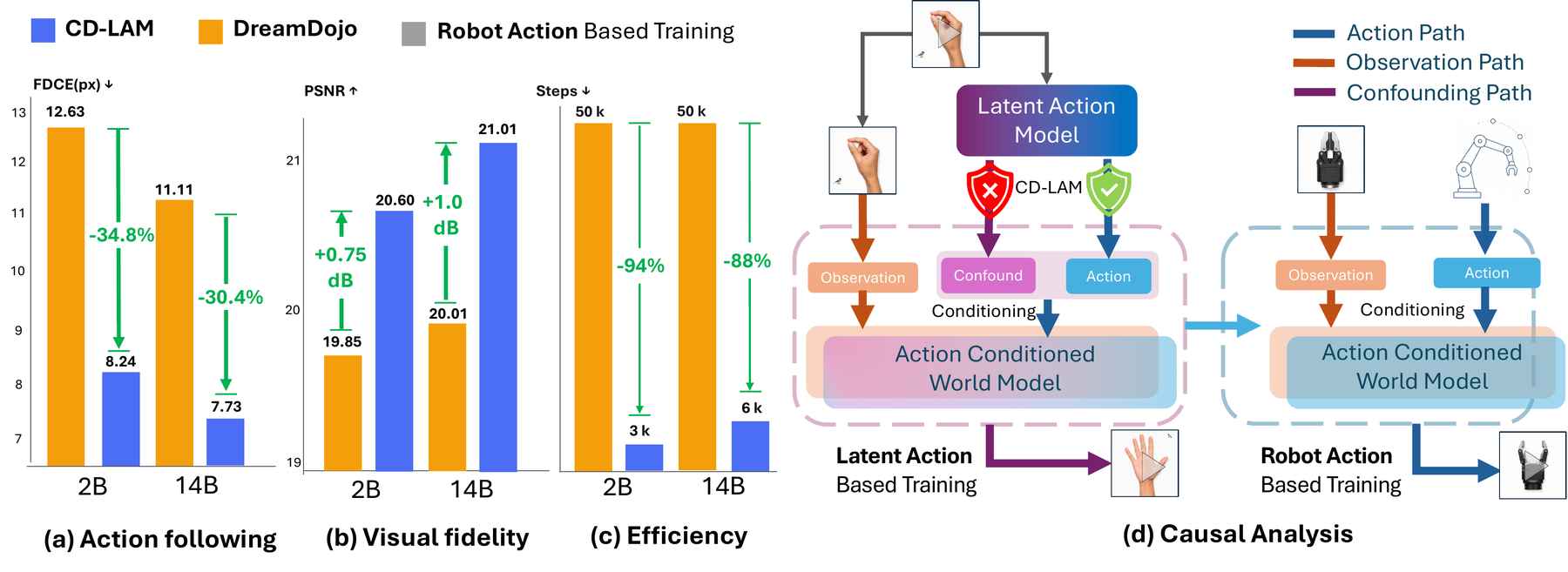
- The results. The world model is now controlled by the action it is given. Action-following error comes down by over 30% at both the 2B and 14B scales. Set the action to zero and the scene comes over 70% closer to holding still at 14B. Hand the model a target action lifted from another episode and the generated motion follows it. CD-LAM is also efficient on two counts. On training efficiency, 3,000 post-training steps reach what the baseline needs 50,000 for. On data efficiency, 1 hour of debiasing video delivers about 80% of the gain from 1,000 hours. Models and code are open source.
Research brief
A video walkthrough of the argument in this article. Why a realistic world model can still ignore the action it is given, where the confounding enters, and what changes once the action space is debiased. The clip is narrated.
Humans can effortlessly imagine what an action will do before making it. Loosen your grip and the cup falls. Push forward and the drawer slides shut. Before the hand even moves, the brain has already rehearsed the outcome. For robots, an embodied world model plays that role. Given the current observation and a future action, it predicts what the scene will look like once the action is executed, so a robot can "dream" before acting. Planning, policy evaluation, and data augmentation all rest on that ability. Realism alone does not get you there. A dream is only useful if it changes when the action changes.
Modern embodied world models use a latent action model (LAM) to turn human video transitions into latent actions that serve as labels for pre-training. That unlocks training on massive amounts of ordinary unlabeled video. The pipeline then runs from LAM labeling to world-model pre-training to robot-action post-training, and every downstream stage inherits the action space the LAM produced.
World models trained along this route have a problem. The generated video is convincing while the action condition is barely in control. We view this as a causal failure and treat it as a question for causal AI. A world model should learn that actions cause futures. The action is the cause, and the frame is the effect. Standard LAMs are trained through next-frame reconstruction, which encodes action-irrelevant factors such as background motion alongside embodiment dynamics. We call this visual confounding. The world model then learns a confounded relation between action and future, and the bias carries on into robot-action post-training.
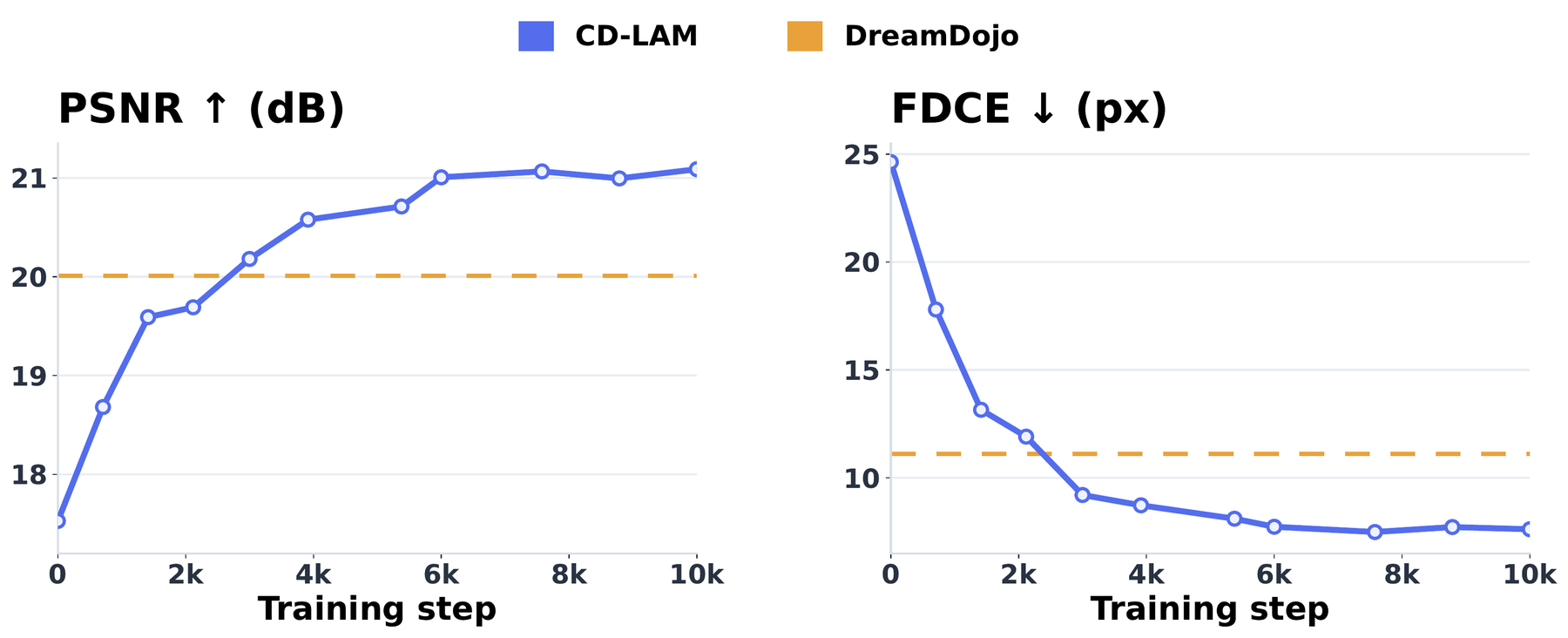
Our answer is CD-LAM (Causally Debiased Latent Action Model). It leaves the world model's backbone architecture, latent action dimension, and action interface untouched, and it debiases the LAM's latent actions before any world model trains on them. Action-following error then falls by over 30%, and visual fidelity goes up at the same time. Post-training then needs roughly 3k steps to match what the baseline reaches in 50k, more than a 10x gain in efficiency.
- TitleCausally Debiased Latent Action Model for Embodied Action Conditioned World Models
- Paperhttps://arxiv.org/abs/2607.09185
- Codehttps://github.com/yufanwei/CD-LAM
- Projecthttps://yufanwei.github.io/CD-LAM-project-page/
01Tracing Intervention Failures to Visual Confounding in the LAM
Most existing LAMs are trained with a video-reconstruction objective, which never asks whether a frame change was caused by the robot's action, by camera motion, or by a lighting change. To reconstruct the next frame more faithfully, the model folds background continuity, object appearance, and camera drift into the latent action, none of which the action caused. The world model's understanding of action during pre-training comes mostly from the LAM's output, so it inherits the same shortcut and guesses the next frame from scene cues. In causal terms, the latent action is confounded, and more reconstruction accuracy will never remove it. Identifying confounders like this one is what causal intelligence is for.
Intervention is the most direct test of causality. Change the cause and see whether the effect changes. For a world model, that means changing the action and checking whether the generation follows. We designed two intervention tests.
Zero-action test · do(u = 0)
The first is the zero-action test. Hold the initial frame constant and set every subsequent robot action to zero. Ideally the arm should stay still. The baseline's generated arm keeps moving visibly, while CD-LAM's residual motion is much smaller.
With every action input zeroed, the correct prediction is a still frame. The baseline roughly replays the motion suggested by the scene context, motion that never came from the action command. CD-LAM's residual motion is far smaller. (Example from the 14B models. FDCE is this sample's residual-motion error.)
Target-action test · do(u = utar)
The second is the target-action test. Keep the initial frame unchanged and replace the action input with an action sequence transplanted from a different video. Ideally the generated trajectory should follow the new actions. The baseline's generated video barely changes at all.
The initial frame stays fixed and the action condition is swapped for a target action sequence. The baseline's generated trajectory shows no clear response to the new actions. (Example from the 14B models. The CD-LAM comparison on the same test is in Section 04.)
The cause changed. The effect didn't.
To trace the source of the problem, we probed the upstream LAM encoder directly. The baseline LAM responds strongly to identical frames, camera shifts, and episode context, all of it action-irrelevant. Those factors end up encoded in the latent actions.
| Diagnostic | DreamDojo LAM | CD-LAM |
|---|---|---|
| Zero-transition response · two identical frames (relative norm, lower is better) | ||
| Median response | 0.527 | 0.043 |
| Absolute latent norm (median) | 3.119 | 0.226 |
| Camera-shift robustness · synthetic translation (relative response, lower is better) | ||
| Horizontal shift (mean / median) | 0.555 / 0.536 | 0.156 / 0.096 |
| Vertical shift (mean / median) | 0.545 / 0.529 | 0.110 / 0.064 |
| Action-neighbor structure · hard-negative diagnostic (lower is better) | ||
| Scene-shortcut leakage | 0.151 | 0.014 |
Does the LAM encode action-irrelevant information into its latent actions? The three probes check whether two identical frames still produce a nonzero latent action, whether shifting the camera changes the latent noticeably, and whether the latent space is organized by scene or by action. "Scene-shortcut leakage" measures whether different actions from the same episode get encoded closer together just because they share scene context. All probes evaluate the LAM encoder alone, with no world-model generation involved. Lower is better.
02Looking Right Isn't Acting Right
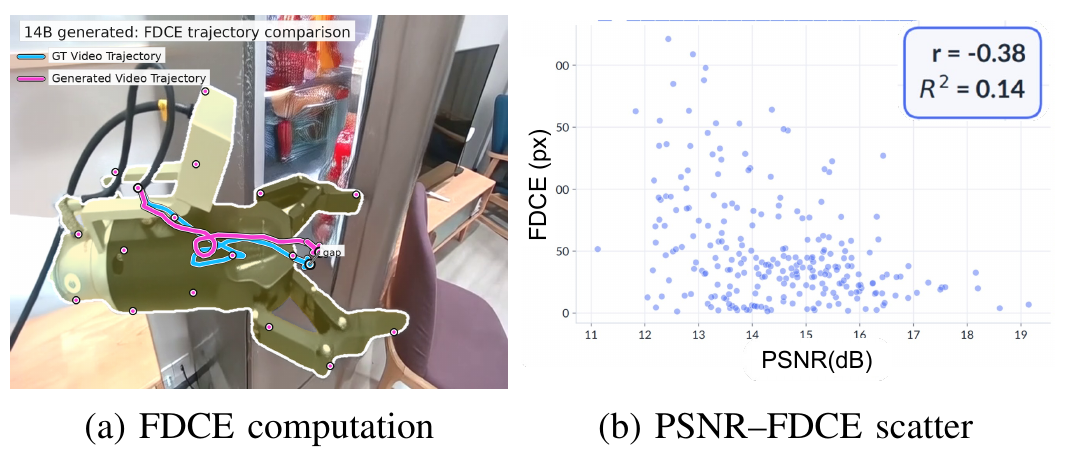
Generic metrics such as PSNR measure visual fidelity, the pixel-level similarity between a generated frame and its reference. Our analysis shows that PSNR explains very little of the action-following error, so it can hardly tell whether the model actually followed the given action. Borrowing from point-tracking-based motion evaluation in video generation, we propose FDCE (Foreground Displacement Chamfer Error) for embodied manipulation. FDCE first segments the foreground regions with SAM3, namely the robot arm and the manipulated objects, then tracks the motion of foreground points with CoWTracker, and finally computes the Chamfer distance between generated and reference displacement tracks as the action-following error. We still report PSNR, SSIM, and LPIPS for visual fidelity.
03CD-LAM: Debias the Latent Actions First, Then Connect Real Control
CD-LAM turns our causal analysis into a training recipe. It leaves the world model's backbone untouched and debiases the LAM's latent actions upstream. Training proceeds in three stages. LAM debiased fine-tuning, then ACWM debiased fine-tuning, then robot-action post-training.
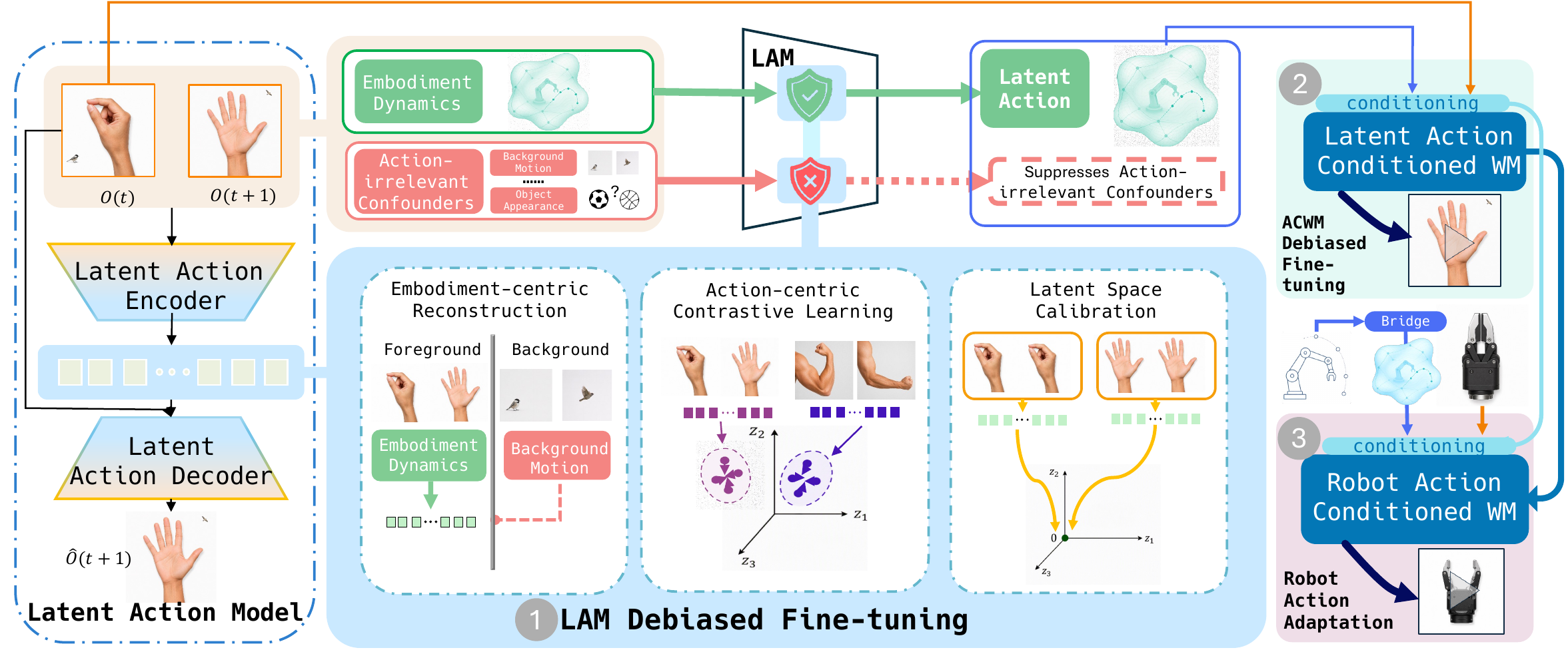
We add three debiasing objectives, combined as a single fine-tuning loss.
where \(\lambda_{\mathrm{ctr}}(k)\) varies with the training step \(k\). The three terms work as follows.
- Embodiment-centric reconstruction \(\mathcal{L}_{\mathrm{emb}}\): turn the next-frame reconstruction loss into a spatially weighted one. Foreground regions such as the arm and the manipulated objects get higher weight through the SAM3 foreground mask \(M_t\), and the background keeps a smaller weight.
\[ W_t = \alpha_{\mathrm{fg}}\, M_t + \alpha_{\mathrm{bg}}\,(1 - M_t), \qquad \mathcal{L}_{\mathrm{emb}} = \frac{1}{|\Omega|}\, \Big\| W_t^{1/2} \odot \big(\hat{o}_{t+1} - o_{t+1}\big) \Big\|_2^2 \]with \(\alpha_{\mathrm{fg}} > \alpha_{\mathrm{bg}}\), \(\Omega\) the pixel grid, and \(\odot\) the elementwise product. Latent actions therefore explain interaction-relevant motion first, and the frame stays globally consistent.
- Action-centric contrastive learning \(\mathcal{L}_{\mathrm{ctr}}\): extract verbs from the videos' text annotations and group them into action primitives such as pick-and-place, pour, and open. A SigLIP-style pairwise loss then pulls same-primitive representations together and pushes different-primitive ones apart.
\[ \mathcal{L}_{\mathrm{ctr}} = \frac{1}{|\mathcal{P}|} \sum_{(i,j)\in\mathcal{P}} \operatorname{softplus}\!\big( -\,y_{ij}\,(\tau\, v_i^{\top} v_j + b) \big) \]where \(v_i\) is the normalized projection of the latent action, \(y_{ij} = +1\) for same-primitive pairs and \(-1\) otherwise, and \(\tau, b\) are a learned temperature and bias. Clusters in the latent action space then form around actions.
- Latent-space calibration \(\mathcal{L}_{\mathrm{cal}} = \mathcal{L}_{\text{KL-fb}} + \mathcal{L}_{\mathrm{zero}}\): when the input is two identical frames, nothing has changed, so the latent action should correspond to stillness. The zero-transition term pushes the norm of such latents toward zero, anchoring them at the origin of the latent space.
\[ \mathcal{L}_{\mathrm{zero}} = \mathbb{E}_{o_i}\!\left[ \left( \left[ \frac{\| z_i^{0} \|_2}{\mathrm{sg}(s_{\Delta}) + \epsilon} - m_{\mathrm{zero}} \right]_{+} \right)^{\!2}\, \right] \]where \(z_i^{0}\) is the latent encoded from a duplicated frame pair, \(s_{\Delta}\) is the running RMS norm of ordinary transition latents, \(\mathrm{sg}(\cdot)\) is stop-gradient, and \([x]_{+} = \max(x, 0)\). The free-bits KL term \(\mathcal{L}_{\text{KL-fb}}\) provides capacity control and prevents the latent space from collapsing.
Together the three objectives ground latent actions in embodiment dynamics. Training then continues in two steps. First the world model is pre-trained conditioned on the debiased latent actions, learning how actions change future frames. Then robot-action post-training runs on real control commands, which a lightweight adapter maps into the same latent action space.
04Lower Action-following Error, Easier Post-training
Latent-action generation is measured on held-out egocentric human video. All evaluations after robot-action post-training use held-out real-robot data with executable actions. The 2B and 14B runs share the same training settings. CD-LAM outperforms the baseline at both stages and makes post-training far more efficient.
Before any robot actions are connected
| Model | FDCE ↓ | PSNR ↑ | SSIM ↑ | LPIPS ↓ | Target-action FDCE ↓ |
|---|---|---|---|---|---|
| DreamDojo-2B | 34.00 | 20.88 | 0.780 | 0.413 | 42.74 |
| CD-LAM-2B | 19.63−42% | 24.29 | 0.827 | 0.308 | 33.81−21% |
| DreamDojo-14B | 40.29 | 21.04 | 0.792 | 0.398 | 50.27 |
| CD-LAM-14B | 29.87−26% | 23.18 | 0.814 | 0.342 | 33.22−34% |
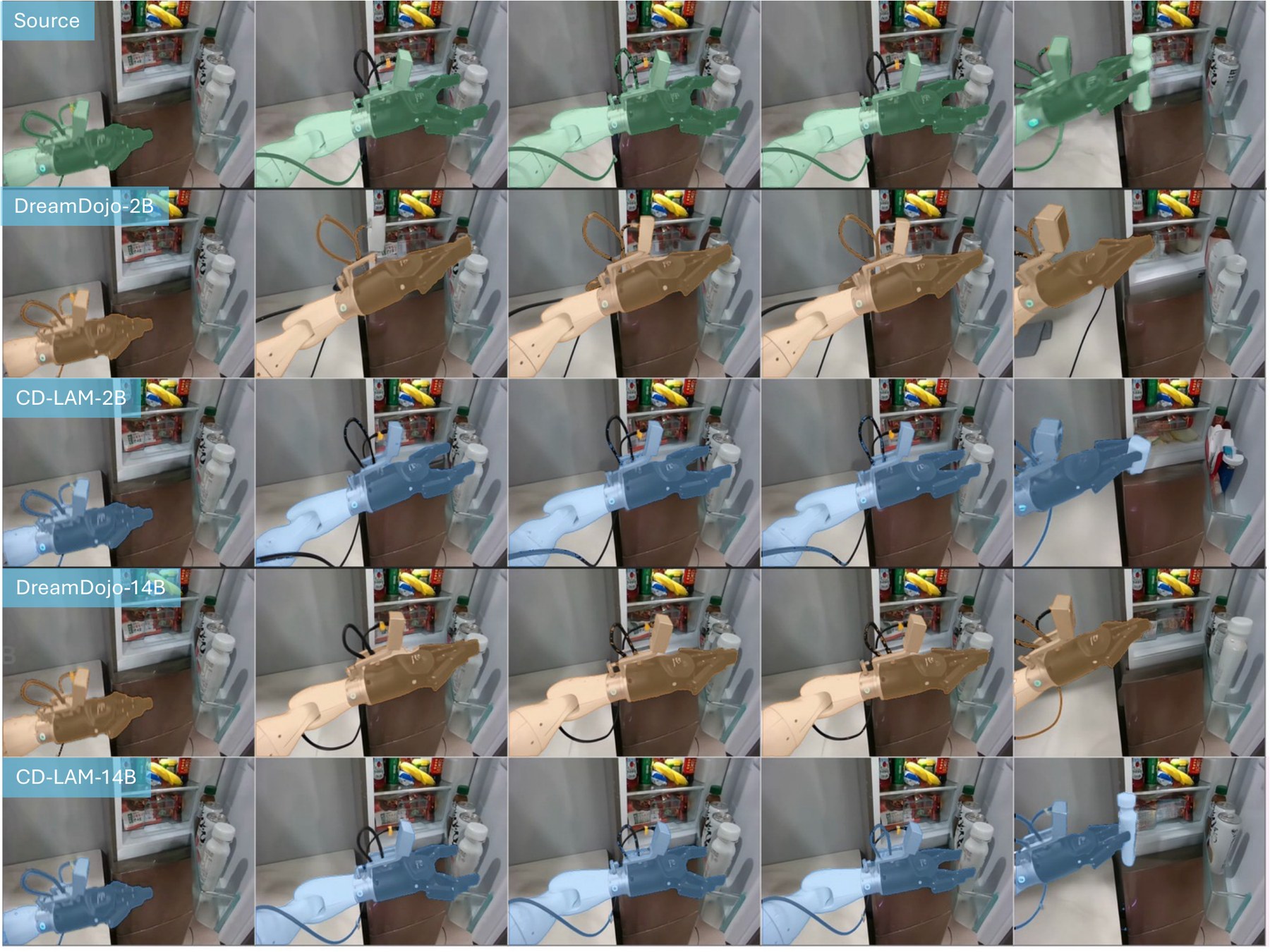
Video generated under latent-action conditioning after ACWM debiased fine-tuning. The left block covers normal generation conditioned on latent actions extracted from the video transitions. The right column covers the target-action intervention, where the initial frame is fixed and the condition is replaced by a target latent action. That column repeats the target-action test from Section 01, and CD-LAM lowers action-following error at both scales.
Using latent actions only, action-following error drops by 42% and 26% for the 2B and 14B models, while PSNR rises by 3.41 dB and 2.14 dB. On the target-action test, 2B and 14B cut action-following error by a further 21% and 34% relative to the baseline.
After post-training on robot actions
| Model | FDCE mean ↓ | FDCE med ↓ | PSNR ↑ | SSIM ↑ | LPIPS ↓ | Zero-action FDCE ↓ | Target-action FDCE ↓ |
|---|---|---|---|---|---|---|---|
| DreamDojo-2B | 12.63 | 8.15 | 19.85 | 0.798 | 0.271 | 10.71 | 24.36 |
| CD-LAM-2B | 8.24−34.8% | 6.75 | 20.60 | 0.806 | 0.269 | 5.03−53% | 22.55−7% |
| DreamDojo-14B | 11.11 | 8.98 | 20.01 | 0.808 | 0.263 | 9.36 | 24.82 |
| CD-LAM-14B | 7.73−30.4% | 5.99 | 21.01 | 0.818 | 0.247 | 2.18−76.7% | 21.11−15% |
Quantitative results after robot-action post-training. The zero-action column is the residual motion when the action is zeroed, where the ideal value is zero. The target-action column is the following error after the action is replaced.
After robot-action post-training on real action data, action-following error drops by 34.8% and 30.4% for the 2B and 14B models relative to the baseline, with PSNR up by roughly 0.75 to 1.0 dB. On the zero-action test, residual motion falls by 53% at 2B and 76.7% at 14B. On the target-action test, 2B and 14B reduce error by a further 7% and 15%, so the generated trajectory now responds much more to the input action. Scaling the baseline from 2B to 14B leaves the drift in place, and on latent-action generation its error gets worse with scale. The gain here comes from the debiasing.
Video example · target-action transfer
With the same initial frame fixed and the target actions swapped in, DreamDojo's arm gradually drifts off the target trajectory, while CD-LAM's generated arm stays closer to the reference motion. (14B models)
1/10 of the post-training updates, from as little as 1 hour of video
The debiasing pays off on training efficiency. CD-LAM reaches the DreamDojo reference within 3,000 to 4,000 steps, against a reference run of 50,000. That is more than a 10x reduction in updates, and CD-LAM clearly surpasses the baseline on both action-following error and PSNR by the final checkpoint. Debiased latent actions lighten the downstream burden, because the world model no longer has to unlearn the reliance on visual confounding it picked up during pre-training.
It pays off on data efficiency too. 1 hour of video for the debiasing already captures about 80% of the benefit obtained with 1,000 hours, so the step stays affordable at any scale of operation.
| Model (debiasing data) | PSNR ↑ | FDCE mean ↓ | FDCE med ↓ |
|---|---|---|---|
| DreamDojo (baseline) | 19.85 | 12.63 | 8.15 |
| CD-LAM · 1 h | 20.54 | 8.91 | 6.88 |
| CD-LAM · 10 h | 20.61 | 8.87 | 6.23 |
| CD-LAM · 100 h | 20.60 | 8.24 | 6.75 |
| CD-LAM · 1000 h | 20.64 | 7.97 | 6.12 |
Effect of the amount of debiasing video. Each tier debiases the LAM with a different number of hours of video, then applies the identical robot-action post-training setup on the same 2B model. Stage 1 is fixed at 1,000 training steps for every tier, which rules out training-budget differences and isolates the effect of data volume.
World models are being scaled as if realism were the main bottleneck. Our results point to a more fundamental one. Causality. Before asking a model to imagine sharper and more convincing futures, we should ask whether it has learned which future an action causes, and whether it responds reliably to the action it is given.
At Aether AI, CD-LAM is one step in a broader effort on causal AI for embodied systems, toward causal world models that respond to interventions the way the physical world does. Full details are in the paper, and the models, evaluation protocols, and training code are all open source.