
Over the past few years, large language models and multimodal models have grown steadily more capable. Digital agents have moved from “being able to chat” toward “being able to complete tasks.” They can click through websites, operate software, invoke tools, write programs, and even carry out complex, multi-step workflows across applications.
But when an agent enters a genuinely unfamiliar environment, the challenges often only begin. New software brings new interaction logic; new tools require different ways of calling them. Each environment also has its own hidden constraints, exceptional states, and failure modes. Even a model with strong reasoning abilities may not understand the environment’s causal structure: which actions lead to which outcomes? Which conditions trigger failure? Which factors actually determine whether a task is complete? This knowledge often emerges only through active probing, intervention, and observation.
A straightforward solution has been to collect new interaction data and retrain the model through fine-tuning, reinforcement learning, or human feedback. But this route is not always practical. Collecting and annotating data, then training on it, is expensive. In enterprise software, private work environments, and constantly changing digital systems, data is often difficult to make public, and frequent retraining may be impractical.
This raises a more direct question:
Without updating its parameters, can an agent learn like a person—exploring a new environment, discovering its causal regularities, consolidating experience, and continuously improving?
Aether AI, together with UCSD and UIC, introduces RSIAgent: an Autonomous Exploration for Recursive Self-Improvement framework for digital agents. The agent decides what to learn, enters the environment to acquire experience, verifies the outcomes, and consolidates stable action–condition–outcome causal relationships into memory for subsequent tasks to reuse.
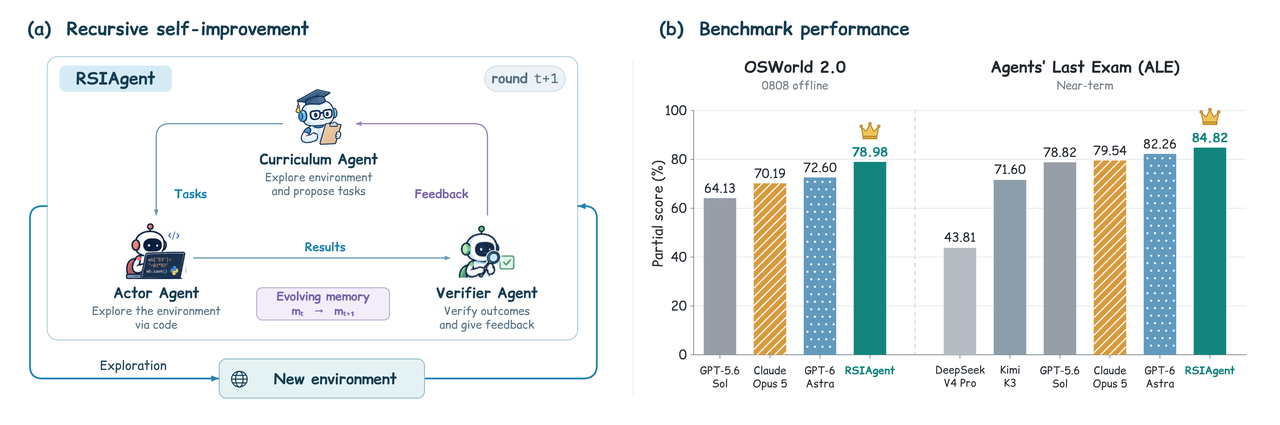
Without updating model parameters, RSIAgent improves the agent capabilities of open-source models such as Kimi-K3 and GLM-5.3, surpassing closed-source models such as GPT-6 Astra on OSWorld 2.0 and Agents’ Last Exam. RSIAgent achieves a partial score of 78.98% on OSWorld 2.0 (0808 offline) and 84.82% on Agents’ Last Exam (Near-term), ahead of GPT-6 Astra’s 72.60% and 82.26%, respectively.
Paper · Code · Website
RSIAgent: Autonomous Exploration for Recursive Self-Improvement in New Environments
- Paper
- Link forthcoming
01From passive learning to active exploration: RSIAgent’s core idea
At its core, RSIAgent turns interaction with a new environment into an ongoing learning process. Around an evolving memory, the system builds a multi-agent recursive loop comprising a curriculum agent, an actor agent, and a verifier agent. The curriculum agent decides what to explore next; the actor agent enters the environment to execute tasks and acquire experience; the verifier agent uses feedback from the real environment to determine whether the results are reliable. Useful knowledge is then continuously written into memory. Rather than passively completing tasks, the agent can autonomously choose learning directions, acquire experience, and expand its knowledge of the environment.
Building on this loop, RSIAgent uses a broad-to-deep, two-stage self-exploration strategy. Its rationale resembles pre-training followed by post-training in large models: first establish broad capability coverage through diverse exploration, then reinforce the ability to handle critical difficulties.
Stage 1Broad Recursive Self-exploration
This stage is analogous to pre-training. The emphasis shifts from solving an individual task to quickly building a broad understanding of the environment. In each round, the curriculum agent generates several exploration tasks in different directions—for example, trying different tools, interaction methods, or input conditions. Multiple actor–verifier agent pairs execute and verify them in parallel, consolidating useful experience into shared memory. Based on what has already been learned, the curriculum agent proposes another batch of valuable tasks that cover new directions. The result is a parallel recursive chain:
Tasks in multiple directions→Parallel execution→Parallel verification→Consolidate and update memory→New tasks in multiple directions
By continually expanding the directions of exploration, Broad Recursive Self-exploration quickly covers common rules, operating procedures, and failure modes. It first builds a relatively comprehensive “map of environment knowledge,” laying the foundation for deeper exploration of critical difficulties.
Stage 2Deep Recursive Self-exploration
This stage is closer to post-training. Its focus shifts from covering more knowledge to overcoming critical difficulties, actively seeking problems that are hard, hidden, error-prone, or exposed only under complex conditions. The curriculum agent first generates a relatively difficult task, deliberately taking the system into situations where exceptional states, hidden constraints, or boundary cases may arise. The actor agent uses the current memory to perform the task, and the verifier agent checks the outcome. The curriculum agent then designs a harder task based on the failures, unknowns, and weaknesses just uncovered. The process becomes a sequential recursive chain:
Difficult task→Execution→Verification→Update memory→A harder task
Each round builds on the knowledge acquired in the previous one. Deep Recursive Self-exploration therefore resembles automated “stress testing”: it continually pushes the agent toward the boundaries of its knowledge, helping it understand where the environment is most likely to cause problems.
Finally, the memory accumulated through both stages is frozen and reused directly for subsequent task execution. The agent gains reusable capabilities for a new environment without updating its model parameters.
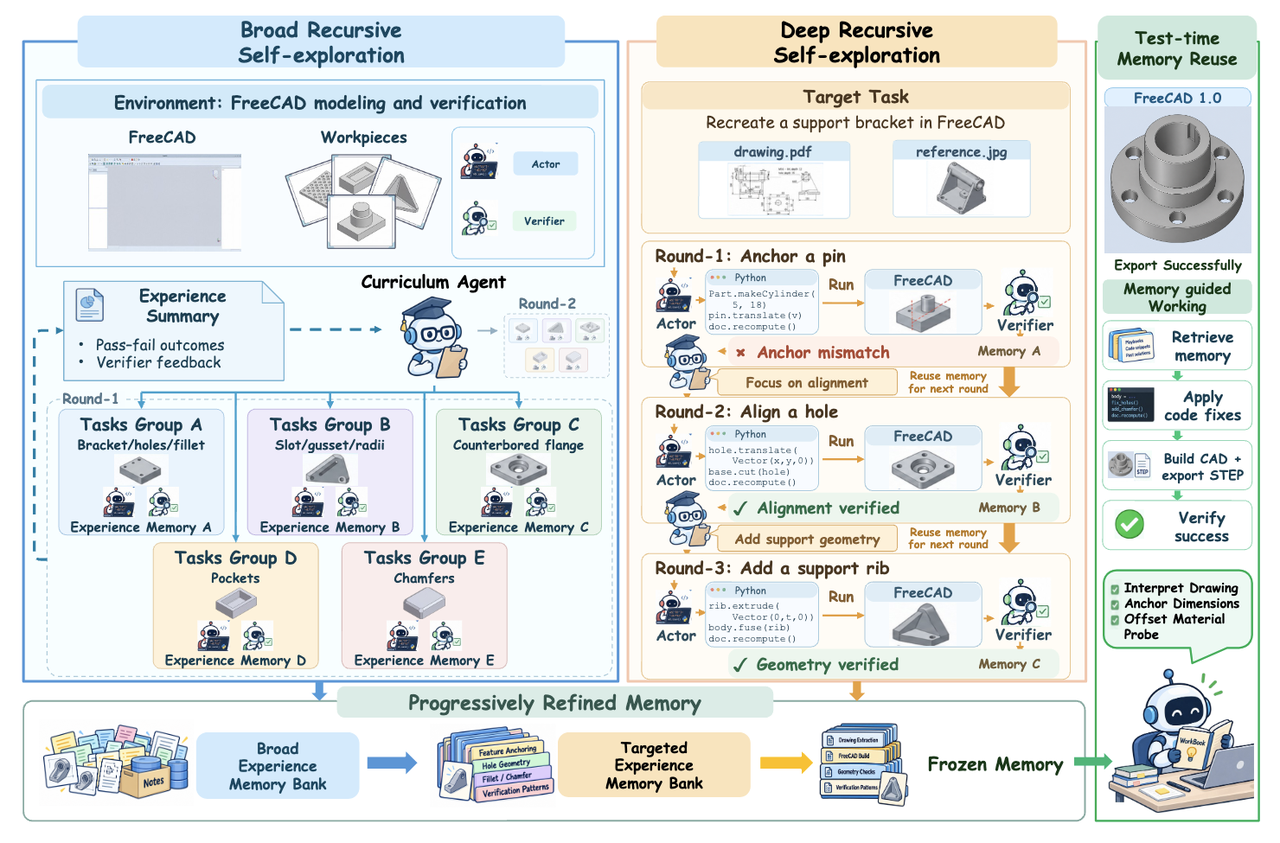
From exploration to execution: RSIAgent in real software
02Experimental analysis
1.Taking open-source models beyond frontier closed-source models
On OSWorld 2.0 and Agents’ Last Exam, RSIAgent builds on the open-source models GLM-5.3 and Kimi-K3. Its RSI strategy raises the OSWorld 2.0 score from 71.97% to 78.98%, well above frontier closed-source models such as GPT-6 Astra and Claude Opus 5. This shows that, even without parameter updates, agents can continue to extend the capabilities of their underlying models through autonomous exploration and memory evolution.
| Model / method | OSWorld 2.00808 offline / 82 tasks | Agents’ Last ExamNear-term / 67 tasks | ||
|---|---|---|---|---|
| Partial (%) | Binary (%) | Partial (%) | Binary (%) | |
| Open-source models | ||||
| Kimi-K2.6 | 22.10 | 4.60 | 21.70 | 9.20 |
| MiMo-V2.5 | — | — | 23.60 | 8.60 |
| DeepSeek V4 Pro | — | — | 43.81 | 19.90 |
| Qwen3.8-Max | — | — | 52.50 | 27.00 |
| Kimi-K3 | 58.30 | — | 71.60 | 40.30 |
| Closed-source models | ||||
| Claude Opus 4.8 | 54.80 | 20.60 | 64.00 | 43.30 |
| Gemini-3.8-Flash | 59.00 | — | — | — |
| GPT-5.6 Sol | 64.13 | 28.10 | 78.82 | 47.76 |
| Muse Spark 1.3 | 66.90 | — | — | — |
| Claude Fable 5 | — | — | 71.10 | 37.30 |
| Claude Opus 5 | 70.19 | 34.72 | 79.54 | 46.27 |
| GPT-6 Astra | 72.60 | — | 82.26 | 52.24 |
| Ours · Using open-source models | ||||
| RSIAgent (w/o RSI) | 71.97 | 37.80 | 83.75 | 49.25 |
| RSIAgent | 78.98 | 42.68 | 84.82 | 50.75 |
—: not reported in the cited benchmark leaderboards or official technical reports. Original table ↗
2.Extending RSIAgent to game environments
We also apply RSIAgent to autonomous game development on GameCraft-Bench. The results show further improvements in mechanics, depth, visuals, art, and overall quality, indicating that its active-exploration and self-evolution mechanism can transfer to different types of interactive environments.
| Method | Mechanics | Depth | Visuals | Art | Overall ↑ |
|---|---|---|---|---|---|
| Generator: Codex + GPT-5.5 (high) | |||||
| Baseline | 61.5 | 53.0 | 54.7 | 47.9 | 52.77 |
| + Play2Code | 60.0 | 50.2 | 52.2 | 47.5 | 51.05 |
| + RSIAgent (w/o RSI) | 66.4 | 57.1 | 59.3 | 53.8 | 57.84 |
| + RSIAgent | 69.7 | 61.0 | 62.6 | 57.1 | 61.28 |
| Generator: Kimi-K2.6 | |||||
| Baseline | 43.5 | 33.5 | 34.1 | 22.6 | 31.28 |
| + Play2Code | 48.9 | 36.5 | 40.9 | 27.9 | 36.02 |
| + RSIAgent (w/o RSI) | 55.2 | 43.1 | 47.0 | 34.6 | 42.61 |
| + RSIAgent | 59.0 | 47.2 | 50.8 | 38.1 | 46.37 |
| Generator: GLM-5.3-Flash | |||||
| Baseline | 36.5 | 29.6 | 31.4 | 28.5 | 30.55 |
| + Play2Code | 48.6 | 37.6 | 40.0 | 33.7 | 38.25 |
| + RSIAgent (w/o RSI) | 55.1 | 44.0 | 47.3 | 40.1 | 44.73 |
| + RSIAgent | 59.2 | 48.1 | 51.3 | 43.8 | 48.72 |
3.Ablating BRS and DRS
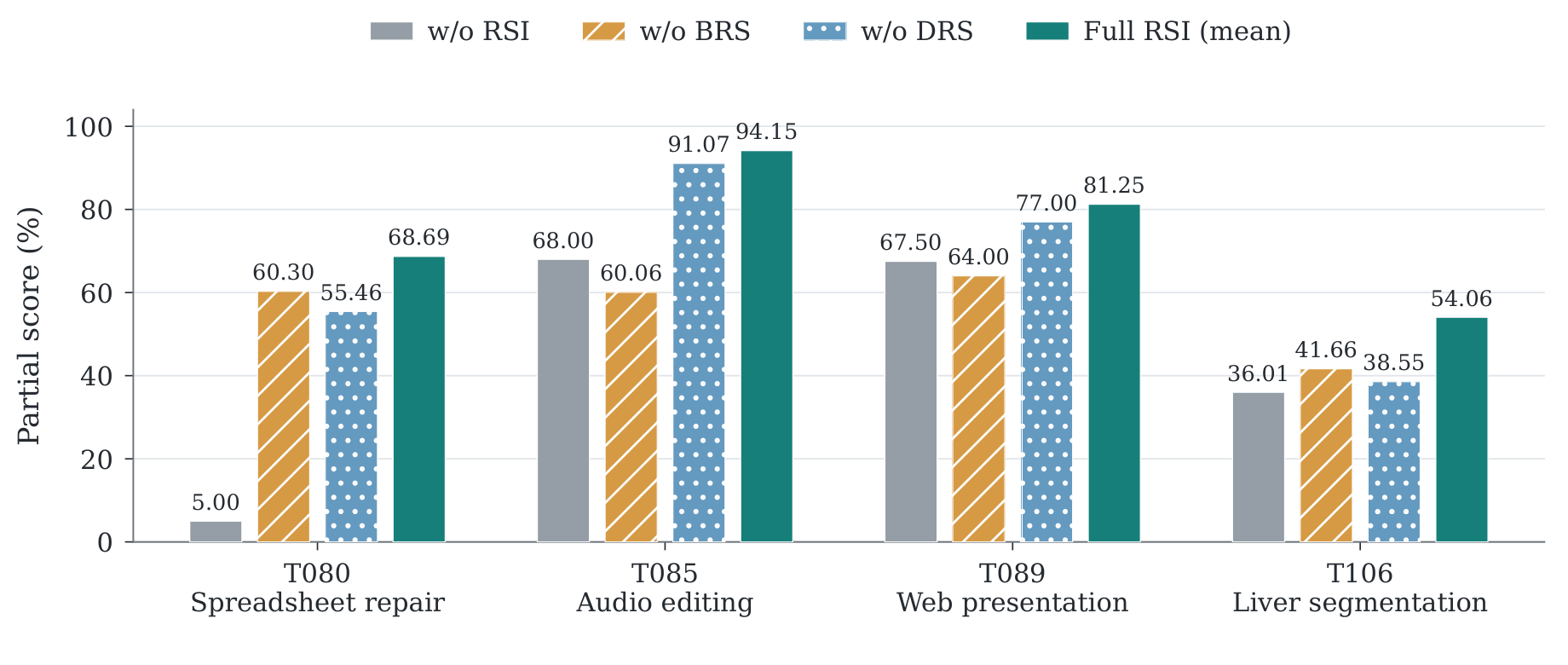
The ablation study demonstrates the importance of both Broad Recursive Self-exploration and Deep Recursive Self-exploration. The broad stage quickly establishes coverage of environment knowledge; the deep stage focuses further on difficulties, hidden constraints, and boundary conditions. Removing either stage substantially affects the breadth or depth of exploration.
4.More RSI rounds, continued self-evolution
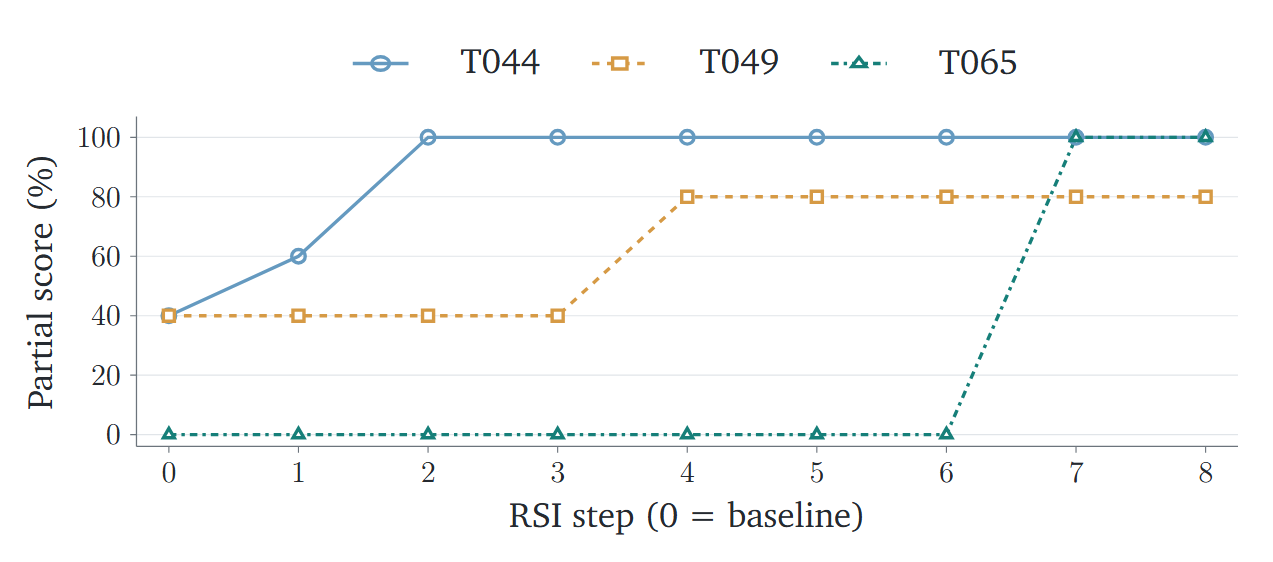
As the number of RSI rounds increases, agent performance continues to improve. Tasks converge at different rates depending on their difficulty: simpler tasks may reach high scores quickly, while complex tasks require more rounds of exploration to resolve the remaining bottlenecks. On representative tasks, final scores can reach 100%, reflecting a process of recursive evolution reminiscent of human exploration and learning.
03Toward active causal discovery and learning: Scaling Experience for Agents
Over the past few years, advances in AI have largely depended on scaling models. Yet this paradigm remains fundamentally “train first, deploy later.” When a model encounters new software, tools, or environments, it often requires another round of data collection and additional training. It lacks the ability to autonomously develop new knowledge during deployment.
To address this problem, the Aether AI team has been advancing autonomous causal discovery, memory evolution, and self-learning in agents. Causal-Copilot explores how agents can autonomously carry out causal analysis, going beyond correlation to identify the factors that truly influence outcomes. C-World creates open-ended tool-use environments in which agents can continuously test, acquire experience, and construct data through more complex and open-ended interactions. Building on this foundation, Auto-scaling Continuous Memory and Hybrid Self-evolving Structured Memory investigate how this continually generated experience can become scalable, evolving long-term memory. StructAgent further brings these capabilities together in long-horizon digital agents, organizing state, execution, and verification through a unified causal structure.
RSIAgent seeks to move agents from passive training toward active causal discovery and learning—and, ultimately, genuine self-evolution. In a new environment, the agent does not merely record trajectories. It actively decides what to explore next, applies different interventions through ongoing interaction, probing, and verification, and observes their consequences. In doing so, it can gradually discover causal relationships between actions, conditions, and outcomes: which operations cause which changes, which conditions lead to failure, and which key factors can be changed to alter the final result.
This creates another path to scaling: Scaling Experience. With model parameters held fixed, RSIAgent expands the scope of exploration through successive RSI rounds, discovers new causal regularities and environment mechanisms from successes, failures, and boundary cases, and consolidates them into evolvable memory. Memory becomes more than a store of past experience: it gradually develops into a reusable understanding of the environment’s causal structure, supporting subsequent decisions and continued self-evolution.
Tasks of different difficulty also exhibit different “rates of evolution.” Simple tasks may converge after a few RSI rounds, while complex tasks require more active exploration to uncover hidden variables, unknown constraints, and corner cases. In the experiments, some tasks that initially score only 0–40% eventually reach 100% as RSI rounds increase.
The future ceiling of an agent’s capabilities may therefore depend not only on how strong its underlying model is, but also on whether it can continually discover, verify, and accumulate causal knowledge through active intervention—and turn that knowledge into enduring, reusable capabilities. Aether AI will continue pursuing this direction: enabling agents not merely to remember what happened, but to gradually understand why it happened and how changing the causes can change the outcomes, ultimately achieving reliable autonomous evolution.
References
RSIAgent: Autonomous Exploration for Recursive Self-Improvement in New Environments
Sibo Zhu†, Shicheng Fan†, Xinyue Wang†, Wenyi Wu, Kun Zhou*, Biwei Huang. 2026.
Causal-Copilot: An Autonomous Causal Analysis Agent
Xinyue Wang†, Kun Zhou†, Wenyi Wu†, Har Simrat Singh, Fang Nan, Songyao Jin, Aryan Philip, Saloni Patnaik, Hou Zhu, Shivam Singh, Parjanya Prashant, Qian Shen, Biwei Huang. 2025.
C-World: A Computer Use Agent Environment Creator
Ziqiao Xi†, Shuang Liang†, Qi Liu, Jiaqing Zhang, Letian Peng, Fang Nan, Meshal Nayim, Tianhui Zhang, Rishika Mundada, Lianhui Qin, Biwei Huang, Kun Zhou*. 2026.
Auto-scaling Continuous Memory for GUI Agent
Wenyi Wu, Kun Zhou*, Ruoxin Yuan, Vivian Yu, Stephen Wang, Zhiting Hu, Biwei Huang. 2025.
Hybrid Self-evolving Structured Memory for GUI Agents
Sibo Zhu†, Wenyi Wu†, Kun Zhou*, Stephen Wang, Biwei Huang. 2026.
StructAgent: Harness Long-horizon Digital Agents with Unified Causal Structure
Wenyi Wu, Sibo Zhu, Kun Zhou*, Aayush Salvi, Zixuan Song, Biwei Huang. 2026.